More Free Things to do in New York City


A group called Free Tours by Foot offers a wide variety of excursions, only suggesting a small monetary donation for their guides.  I was really tempted by their outings to Harlem and Brooklyn, but, because of time constraints, I was happy to settle for the two-hour visit to Greenwich Village.  I met the group, per website directions, in front of the Waverly Restaurant on 6th Avenue.  One of the first things our guide, Derek, did was to give us his cell phone number saying how easy it is to get lost in the labyrinth of the Village.  He explained that when the grid plan was laid out in 1811 to develop the rest of the island there was already a hodgepodge of intersecting streets in lower Manhattan.  Thankfully, our group seemed to manage its way through the maze without any problems.


This historical district, which now contains some of the most expensive real estate in Manhattan, was once a gritty section of town and a haven for many important American authors and entertainers.  Founding Father Thomas Paine, propagandist and author of Common Sense, spent two years living in the area.  Edgar Allan Poe was treated for a head cold at the former Northern Dispensary, which went from being a hospice for the poor to a dental clinic before closing in the mid-1980s.  A long list of poets, novelists, and playwrights—including Willa Cather, William Faulkner, Edna St. Vincent Millay, and John Steinbeck—used to hang out at Chumley’s, a pub turned speak-easy during Prohibition in the 20s and 30s.  Over the decades this part of Manhattan has been home to the famous and the infamous: actors such as Cary Grant and John Wilkes Booth lived here.  Many celebrated musicians and comedians got their start in Greenwich Village as well.  Blue Note Jazz Club on 3rd Street saw the likes of Miles Davis, Arturo Sandoval, and Winton Marsalis.  Just around the corner on MacDougal Street one finds both Comedy Central, where comedians like Dave Chappelle have performed, and Players Theatre (1907), one of New York’s oldest off-Broadway playhouses.

Renowned for its “Be and Let Be” motto, Greenwich Village has been at the forefront of several American social movements.  For many years, emancipated African slaves were granted land in the swampy area around Washington Square.  In the 1960s, The Stonewall Inn on Christopher Street was acclaimed for being the spot where the gay liberation movement began; this bar was the scene of spontaneous riots against the persecution of sexual minorities.  The Village was also the scene of anti-Vietnam War protests in the 70s.

Derek also pointed out the buildings that served as the exterior in television shows such as The Cosby Show, Friends, and Sex and the City.

There is so much to see and do in the city.  Can't wait for our next trip there!

posted under | 0 Comments

Free Tours in Manhattan


Not every metropolis in the world offers as much for free as New York City.  Besides the pleasure of just walking around admiring the great city’s beauty, visitors can take advantage of no-cost excursions to learn about its history, art, and architecture.  Central Park Conservancy (or CPC), for example, provides daily walking tours of various sections of the immense park.   Last Thursday, I enjoyed  their one-hour walk through “The Castle and Its Kingdom.”  Our guide started out by telling us that the area now known as Central Park was originally a rocky, desolate swamp between 59th and 110th Streets.  In the mid-nineteenth century Frederick Law Olmsted and Calvert Vaux won a design competition to develop the 843-acre expanse into a public park.  These two men, architects and landscape designers, wanted a space for citizens and visitors to experience the wonders of nature.  Since its opening in 1857, however, the park had fallen onto hard times and by the nineteen-seventies had become a decrepit and dangerous place to be.  In 1980, a group of civic-minded individuals formed the Conservancy and have been upgrading and maintaining the park’s buildings, lawns, and plants ever since. 

None of the current amusement features, such as the Shakespeare in the Park at the Delacorte Theatre, skating on the ice rinks, or riding the Carousel, were included in the architectural plans.  Olmsted and Vaux, working with another architect named Jacob Mould, did provide for a so-called “Victorian folly,” a decorative element popular at the time, here in the form of Belvedere Castle.  Made of Manhattan schist, the rock which underlies most of the island, the Norman-style fortress was initially designed to have two towers, but its creators settled for one when the project ran low on funds.  The castle, which now serves as the park’s Visitors’ Center, is located high up on Vista Rock and offers nice views of much of the mid-park area.  To the north, one can see the man-made Turtle Pond, at one time part of the Croton Reservoir, the former supplier of water to the city.  Beyond the pond is the Great Lawn which was created by filling in sections of the reservoir.  The lawn contains several ball fields, which can be reserved by local teams, and is also used for cross-country skiing in the winter and annual summer concerts (from symphonies to opera to rock--some of them free as well).  On the south side of the castle is the Ramble, a wild, wooded space on thirty plus acres.  The weather from Central Park used to come directly from Belvedere Castle, but now has a sizeable, modernized facility inside the Ramble.


There were some interesting stone structures on our tour.  Of  over thirty bridges and arches in Central Park, we saw the lovely Greywacke Arch.  Its strange name comes from one of the three stones Jacob Mould used to build it.  According to our guide, Mould's interest in Moorish architecture led to the creation of this archway.  Not only is it pretty from the exterior, but the underside is stunning in red brick with light-colored crosses.  The oldest element in the park by far is the 3500-year-old Egyptian obelisk, called Cleopatra's Needle.  Just transporting it to New York proved to be a big problem; William Vanderbilt came up with the idea of cutting a hole in the side of a ship and patching it back up once the 22-ton obelisk was inside.  It then took another 4 months in 1881 to get it from the port on 96th street to its current location.  The structure sits on a base supported by bronze crabs.

We really learned a lot on our free tour; I encourage you to see for yourself.

posted under | 0 Comments

French Gothic Cathedrals


Ken Follett’s The Pillars of the Earth, about the building of a 12th century cathedral in a fictional English town, is an engaging read.  While its style is sometimes strained (you can practically hear the author thinking about how to insert facts on the Middle Ages into the text), the novel sticks with you.  In my case at least, the book had me examining the architecture of churches and older buildings in our area and got me reminiscing about the history of French Gothic cathedrals I’ve seen.  The word “gothic” itself, as you probably know, was originally a derogatory term used by people of the Renaissance (15th century Italians and 16th century Frenchmen) who considered the architecture of the medieval cathedrals as barbaric as the Goths. 

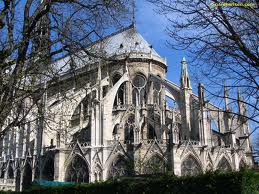
The main innovator in the revolutionary 12th century shift from the bulky, dark, rounded-arch style called Romanesque to a new design he referred to as “modern” was l’Abbé Suger.  In 1137 the abbot, a counselor to Louis VI and Louis VII, decided to rebuild the Basilica of Saint-Denis, the official church of the French king, located about 6 miles north of the center of modern-day Paris.  Because Suger believed that light symbolized the divine, he wanted the new building to be “a crown of light” which would express the grandeur of God.  To this end, the basilica would have high ceilings, created through the use of diagonal ribbed (or ogival) vaults with two intersecting pointed arches.  Used previously in Islamic architecture in the Near East, these architectural innovations paved the way for high, gravity-defying walls by directing the weight to clustered columns.  Flying buttresses, pillars of stone on the outside of the building, provided extra support to carry the weight of the walls and roof; these structures also allowed for more height and for the development of stained glass windows.  Completed in 1144, Saint-Denis became the prototype for Gothic building in northern France.  It is hard to imagine how difficult it must have been for craftsmen of the era to cut through solid limestone, forming up to three-ton blocks of stone, and transporting them to the construction site and up to the height required by using equipment like the treadwheel crane or “squirrel cage.”  Another early example of French Gothic cathedrals is Notre-Dame de Paris (begun 1163).  This building also used flying buttresses to relieve wall thrust and resolve stress fractures, and its imposing western façade suggests the majesty and might of God.  


The “new” Cathedral of Chartres (constructed from 1194 to 1260) was one of the first examples of the style known as “high Gothic.”  In fact, Chartres is held to be the crown jewel of Gothic architecture.  Its high clerestory windows, which allowed a more spacious, heightened effect, were to become standard in later churches of this style.  Its world-famous stained glass windows, which depict narratives from the Bible, provide a kaleidoscope of colors; the blue of Chartres's stained glass windows has never been duplicated.  As was the case for many French cathedrals, the windows were carefully removed during wartime and were safely stored away in mines or in the countryside.  The cathedral itself was spared shelling by American troops during World War II when a certain Colonel Griffith questioned the strategy of attacking the church on the assumption that German soldiers were hiding inside its tower.

The Gothic Rayonnant period (which began in the early 13th century), with its more elevated interior, more slender columns, and enormous rose windows, has several stunning examples.  Started in 1220, Amiens, in the northern region of Picardie, was built so tall that a special wrought iron bar chain was installed in 1497 (while the iron was red hot) to hold the structure together.  Unfortunately, while being stored during World War I, nearly all of the church’s stained glass windows were destroyed.  Still, it is a very impressive place to visit.  Another cathedral in this style is Beauvais, which I’ve yet to see.  This church was never completed because parts of it collapsed on two separate occasions; some have suggested that the height of the cathedral combined with its proximity to the high winds of the English Channel have caused its instability.  Perhaps the most beautiful of all Rayonnant houses of worship is Sainte-Chapelle.  The small palace chapel on Île-de-la-Cité in Paris, was built by Louis IX and was consecrated in 1248.  On a sunny day its immense stained glass windows illuminate the interior, giving the impression of heaven on earth.

Visits to the great cathedrals of France (and other European countries) are truly awe-inspiring experiences.  There is so much to contemplate: from the wondrous architecture to the beauty and symbolism of its ornamentation--stained glass windows, paintings, and statues.  Even if you can't be there in person it might be interesting to see the Nova series on the building of the Gothic cathedrals. 
 

posted under | 3 Comments

The Asian Connection


The proliferation of diverse ethnic restaurants in this country over the past few decades is nothing short of amazing.  In the Capital Region, but also in our hometowns, we’ve noticed a drastic change in the dining landscape since we were young.  When we first moved to Albany, in fact, it was hard to find anything but Italian food if we wanted to go out for supper.  Now, choices include Thai, Indian, Greek, Mexican, Lebanese, Afghan…you name it.  In recent months I’ve enjoyed delicious meals at two nearby establishments, interestingly both run by female chefs.


The first, Saigon Spring, is related to one of our longtime loves: Van’s Vietnamese Restaurant on Central Avenue in Albany.  Apparently, Cathy Tran, Van’s mother, decided to set up her own place in the unassuming strip mall of St. John’s Plaza in Halfmoon, just across the Mohawk River near Clifton Park.  Considered one of the ten healthiest ethnic cuisines, Vietnamese food seemingly stems from Chinese and colonial French sources; it is generally high in vegetables and herbs and low in fat.  The offerings at Saigon Spring are extensive without being overwhelming.  On our recent visit we started out with delicious, crunchy pork summer rolls that come with fish sauce.  As for a main dish, it’s always hard for me to resist the traditional, delicious soup called Pho, pronounced fuh which probably derives from France’s pot-au-feu.  I agree with an article by Andrea Nguyen that Pho is “heaven in a bowl."  If you’re unfamiliar with it, the fragrant broth contains slices of beef [Pho Bo] (meatballs, chicken, or seafood) with rice noodles, and scallions, to which you add bean sprouts, sliced fresh jalapeños, lime juice, and Thai basil or cilantro to taste.  It is also served with small bowls of hoisin and chile sauce (often Sriracha) on the side.  The bun selections at Saigon Spring are also fantastic.  Here grilled pork, chicken, beef, or shrimp is served over rice noodles.  Simply writing about these dishes makes my mouth water!  Prices are quite reasonable and they also have interesting sounding milkshakes (like avocado or mango), beer, cocktails, and wine.

Just this week at noon, some friends and I went to a reincarnation of a former Albany favorite of ours, Avenue A.  Back in its last location on Delaware Avenue, the restaurant is now called Mingle.  Chef Un-Hui Filomeno has indeed “mingled” a variety of cuisines in an unusual, wonderful way.  The dinner menu contains classic Caesar salad, Cioppino, and Mediterranean Paella, as well as diverse items like Portuguese clams, and Jambalaya.  The chef also includes several tasty dishes from her homeland: Korean Bulgokee, Chap Chae, Bibimbap, and, my luncheon choice, Kimchi Jigae.  Let me start out by saying that I’m not in love with tofu; in fact, I tend to shun it as a rule.  But I was curious to see what the cook could do by combining it with kimchi.  I really loved the spicy cabbage mixed with the piquant chile paste gochujang.  It’s one of the few ways to serve tofu as far as I’m concerned.

Even if you don't live in our area, I'll bet if you looked around you'd find a Vietnamese or Korean restaurant not too far away.  Give it a try!

posted under | 0 Comments

In Praise of Crème Fraîche


Lately I’ve discovered the wonders of crème fraîche.  Similar to sour cream, but softer, less sour, and thicker, this tangy concoction can be purchased just about everywhere these days, including at your local supermarket.  Making your own is apparently quite simple, though I’ve yet to try it.  All you do is slowly heat one cup of heavy whipping cream (preferably not ultra-pasteurized) and then stir in a tablespoon of buttermilk. This mixture is left to sit, covered, in a warm draught-free place for around 24 hours. It is ready when it is the consistency of thick cream. If it still looks a little runny after 24 hours, leave it another 8 to 12 hours but move it to a warmer spot.  Then you can use it in any recipe that calls for sour cream.  It has twice the calories of its American cousin, but all things in moderation, right?

One reason I decided to try crème fraîche is that it often appears as an ingredient in the daily email recipes I receive from P’tit Chef outside of Bordeaux.  (Once on the site click on “Recevoir le menu du jour” on the right, if you’re interested.)  It’s fun because every day I can read three French recipes—an appetizer, main dish, and dessert—which, at the very least, give me ideas for meals.  Because we try to have one meatless supper per week, I was intrigued by the “Risotto aux champignons” I got from the little chef.  Although the recipes contain weights in grams instead of ounces, you can quickly find equivalents online.  To create the mushroom risotto, gently cook a clove of minced garlic in some butter for a couple of minutes, then add in about 5 ounces of mushrooms.  I found a nice 3-oz. package of sliced shiitakes to which I added a few more of the button variety.  After cooking for 3 minutes, pour in about 3 tablespoons of white wine.  Then spoon in a couple of tablespoons of crème fraîche; salt and pepper to taste and set the mixture aside off the heat.  While bringing a quart of chicken broth to the boiling point, sauté a small onion in some oil for about 3 minutes, then add in a cup of Arborio rice.  Once the rice becomes translucent, stir in one ladle of the hot broth.  After the liquid is absorbed, add in another ladleful, stirring just about constantly; continue until the broth is used up and the rice is cooked.  This should take about 20 minutes.  Put in some grated parmesan and the mushroom mixture.  Et voilà!  It’s quite a tasty dish. 


It’s funny how cooking styles change over the years.  When I was newly married, many cookbooks called for the use of high-sodium canned soups.  I have since adapted some of my old favorite recipes—like Chicken à la Parisienne—found in Better Homes and Gardens New Cookbook.  For this, you put a couple of boneless chicken breasts in a baking dish (browning them first, if you want) and cover them with a mushroom white sauce.  To make the sauce, brown some sliced mushrooms in 2 tablespoons of butter or oil; add in another couple of tablespoons of butter and the same amount of flour and stir for about a minute.  Thin the mixture to the desired consistency with a few tablespoons of white wine and some milk—or a combination of milk and chicken broth.  Stir in a few tablespoons of crème fraîche, season with salt and pepper, and pour over the chicken.  Sprinkle the top with paprika and bake in a 350 degree oven for about an hour. Serve over hot rice or pasta.

Another favorite out of the same cookbook is the recipe for Beef Stroganoff.  This dish can be made with strips of sirloin or simply with ground beef.  Either way, the result is delicious!  First brown the meat (a pound or less) in a little butter or oil, add in some sliced mushrooms, a half-cup of chopped onion, and a minced clove of garlic.  Cook for 3 or 4 minutes and then sprinkle the mixture with a tablespoon of flour.  Pour in a cup of beef broth, a tablespoon of white wine, and a tablespoon of tomato paste or ketchup.  (I sometimes add some chopped fresh dill to the mixture.)  Cook, stirring occasionally, till thickened and bubbly and the meat is tender.  Finally, stir in a few tablespoons of crème fraîche and serve over wide egg noodles.

I hope this post gets your salivary glands working and inspires you to get into the kitchen.  Let me know if you try any of these recipes.  Happy cooking!

posted under | 0 Comments

Jefferson, Part 2


Thomas Jefferson loved architecture, which he considered one of the most important arts.  Nothing gave him more pleasure, he stated, than “putting up and pulling down”—something that he did several times on parts of Monticello.  Although a variety of sources went into the creation of his structures, the president’s “Bible” of design was The Four Books of Architecture by the sixteenth century Italian, Andrea Palladio.  Jefferson believed that developing an American style of architecture, based on but separate from European designs, was an important element of the national cause.  Besides his home outside Charlottesville, Jefferson helped create three other important structures in Virginia.

The cubic architecture of the Virginia State Capitol in Richmond was chosen to resemble an ancient Roman temple.  The only structure of this kind that Jefferson had seen first-hand was the Maison Carrée in the south of France.  However, Jefferson’s design of the state house substituted Ionic scrolls for the more ornate Corinthian columns found at the temple in Nîmes.  The commanding and impressive building is not without tragedy.  When hundreds crowded into the upstairs gallery during Reconstruction following the Civil War in 1870, the balcony gave way causing the death of sixty-one people and injury to scores of others.  Despite calls for its demolition, the building was restored and eventually expanded.  It is still in use today.

During our visit to the state in early January, we were able to see another Jeffersonian design: The University of Virginia.  The president’s retirement project was to develop an “academical village” where professors and students would live and work in close proximity.  Called “the proudest achievement of American architecture in the past 200 years” by the American Institute of Architects, UVA’s focal point is the beautiful Rotunda.  Located at the north end of “the Lawn,” the structure was modeled after the ancient Pantheon in Rome, which Jefferson had read about in sources like Palladio and others.  After a devastating fire in 1895, the architectural firm of McKim, Mead, and White (of Boston Public Library fame) made significant changes to the building’s original design.  But in 1973, a three-year project was begun to restore the Rotunda to the way Jefferson intended.  Initially designed as the campus library, the Rotunda now serves as a place for lectures, meetings, symposia, dinners, and tours.  Unfortunately the day we were there, January 2nd, the building was closed for the federal holiday.  Down the hill to the east and west of the Rotunda, stretch the faculty Pavilions and some student rooms, making for a striking central campus.


While on our guided tour of Monticello, we learned that the building served as Jefferson’s public residence.  His private retreat—to escape the hordes of visitors—was Poplar Forest, located near Lynchburg.  Designed and built during the last twenty years of his life, this plantation house allowed Jefferson to experience “the solitude of a hermit.”  Once again built in accordance with Palladian principles, the Italian-style villa has a central cube room with porticos on the north and south.  Since 1986, Poplar Forest has been undergoing restoration.  Like Monticello, it is open to the public for tours and I would love to see it someday.

posted under | 0 Comments

Jefferson's Virginia, Part 1


In terms of natural beauty, the Commonwealth of Virginia ranks high on my list of east coast destinations.  Every time we drive through the state I’m amazed at the picturesque rolling hills, the Blue Ridge Mountains, and plains of grazing animals.  At Christmas we had the use of a GPS which routed us through some small country roads, giving us an even greater appreciation for the attractiveness of area.  But, obviously, Virginia has much more to offer visitors than simple geography.  Just driving along the highway seeing signs for Antietam and Appomattox Court House causes one to reflect upon and desire to learn more about our nation’s history, specifically the American Civil War.  Because we were so close to Charlottesville on our return trip from North Carolina, we decided to stop by and see some of the great buildings designed by President Thomas Jefferson…and we were not at all disappointed in our decision.

Perhaps the cooler temperatures of January in northern Virginia kept down the crowds; in any event, the actual experience of paying a visit to Jefferson’s Monticello was much more pleasant than fighting through the Biltmore Estate had been a few days before.  Included in the winter entry fee (of $17) is a tour of the mountain-top home, named from the Italian word for little mountain.  First constructed in 1772 and entirely redone in 1796, the current building has many architectural marvels that Jefferson either conceived of himself or adapted from his knowledge of French architecture from the time he served as ambassador to France in the late eighteenth century.  In the entrance hall, for instance, there is a clock, still functioning today, which tells both the day and the time.  The home contains 13 skylights, symbolic griffins in crown molding, and triple-sashed windows.  There is also an octagonal–shaped guest room (often used by another former president James Madison and his wife), a very bright chrome yellow dining room complete with two wine dumbwaiters, and a library which once held over 6,000 volumes (subsequently donated by the president to the Library of Congress after a fire destroyed its collection).  Jefferson designed his bed in a kind of alcove which allowed him to get up either on the right side into his cabinet (“study”) or on the left into his dressing room.  We learned that he soaked his feet in a bowl of cold water upon rising to wake up each morning!  (Wouldn't catch me doing that...)  A set of stairs in the dressing room leads up to a closet which used to contain Jefferson's clothing.  The kitchen, wine and beer cellars are also available to see in the basement of the house.

Besides the understated splendor of the neoclassical building, there are many interesting decorative elements as well: elk antlers sent by Lewis and Clark from their transcontinental expedition, native American art similar to that prized by the former president, and famous portraits of Jefferson by Thomas Sully and Gilbert Stuart.  Visitors can also walk around the property and see the president’s grave, the fish pond, and the gardens.  Thomas Jefferson was a true renaissance man whose broad interests and expertise were nothing short of outstanding.  A politician, architect, traveler, avid reader, rabid learner, and speaker of several languages, he even taught himself to read Spanish during his transatlantic trips to Europe.  A trip to Monticello helps tourists to understand what prompted President Kennedy to tell a group of Nobel Prize winners at a dinner at the White House: "I think this is the most extraordinary collection of talent, of human knowledge, that has ever been gathered together in the White House—with the possible exception of when Thomas Jefferson dined alone."  Next week we'll examine other architectural accomplishments of this great man.

posted under | 0 Comments
Newer Posts Older Posts Home

Counter


Followers


Recent Comments